
Home /Technology /How LaserGauge Works
How LaserGauge® acquires a 2-D Surface Contour through Laser Triangulation
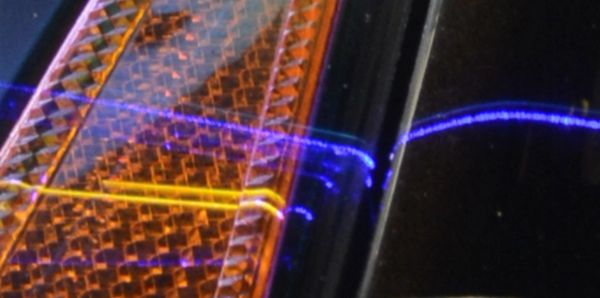
The LaserGauge® acquires a 2-D contour of the surface to be measured, much like a linear “point cloud”, such that all of the points line up in the same measurement plane. In a typical LaserGauge®, up to 1280 points in a contour can be acquired. Since these contours are taken at a fixed scan width, the point spacing in the contour is dependent upon the scan width and the number of sample points. For example, for a 1-inch scan width with 500 points per scan, the sample spacing of the contour is 0.002”. Typical depth resolution is 0.001” for a 1” scan but can be as small as 0.0002” for smaller scan widths.
LaserGauge® is not limited to the single laser stripe technology. Other structured light methods are utilized to allow for measurements on different types of components, each with its own advantages.
Single Stripe Scanning
Several LaserGauge® sensors use single-line imaging for surface contour measurement. While not able to provide 3D information of a surface, it is the most compact, fastest, and most multi-purpose of the laser imaging models.
SCANNING DIAGRAM

SAMPLE SCAN

Cross-Vector Scanning
Cross-Vector sensors utilize lasers angled toward the inside edges of the gap, crossing in the middle. This allows the sensor to see around edges of the radius to the vertical tangent and beyond. The result is a complete surface profile and the most accurate gap measurements.
SCANNING DIAGRAMS


SAMPLE SCAN

ADVANTAGES:
- Multiple lasers/views
- Able to see around edges
- No movement necessary
AVAILABLE SENSORS:
Leading Edge Scanning
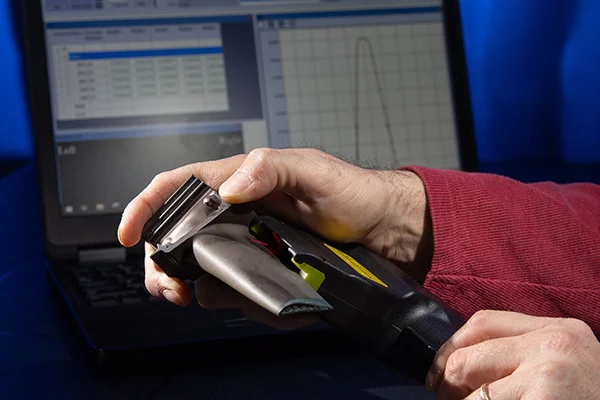
The leading edge imaging method yields scans on both sides of a part simultaneously. The structured light reflects off one surface, around the edge, then onto the other surface, giving true leading edge scans that can then be processed. The traditional laser triangulation method is unable to do this.
Selection of Red vs Blue laser technology comes down to a question of the surface material being measured. Red Laser technology is used on solid surfaces, such as painted or unpainted, non-shiny surfaces. Blue laser technology works accurately on all kinds of surfaces including painted, unpainted, translucent, transparent, some plastic, composite, and shiny.
The photos below show the difference between the blue laser (left) and the red laser capability on a red translucent lens:

BLUE LASER ON AMBER TRANSLUCENT LENS
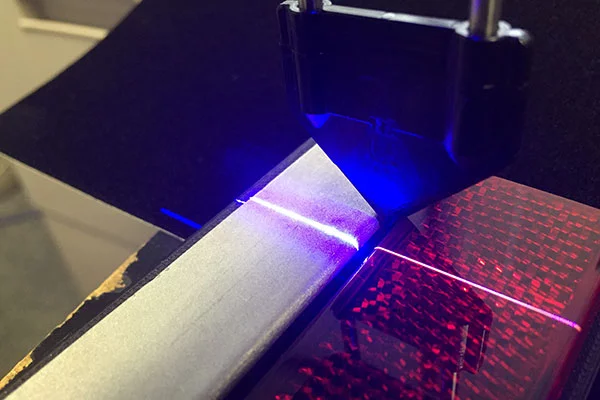
BLUE LASER ON RED TRANSLUCENT LENS
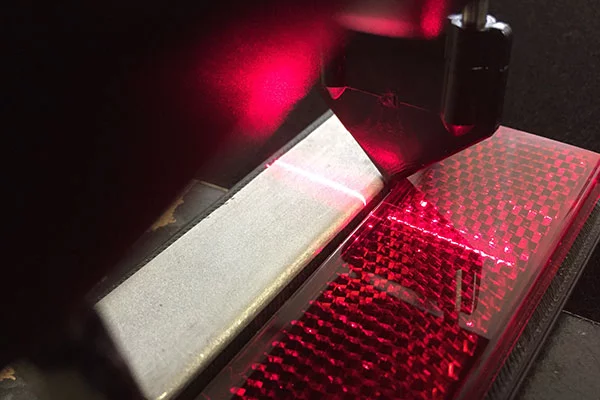
RED LASER ON RED TRANSLUCENT LENS

LASERGAUGE® IS PART OF THE LMI CORPORATION FAMILY OF PRODUCTS.
LaserGauge® products and solutions are trusted and used by leading manufacturing companies around the world.
